
Pharmaceutical tablets may be defined as the solid unit dosage form of one or more medicaments with or without suitable excipients and prepared either by molding or by compression.
A tablet comprises a mixture of active substances and excipients, usually in powder form, pressed or compacted from the powder into a solid dose. The compressed tablet is the most popular dosage form in use today. About two-thirds of all drugs currently prescribed are in solid form in half and of these are as compressed tablets.
- Type of Tablets in Pharmaceutics
- MCQs: Types of Tablets
- Frequently Asked Questions (FAQs) on Types of Tablets
- 📢 Join Our Pharma Community
Type of Tablets in Pharmaceutics
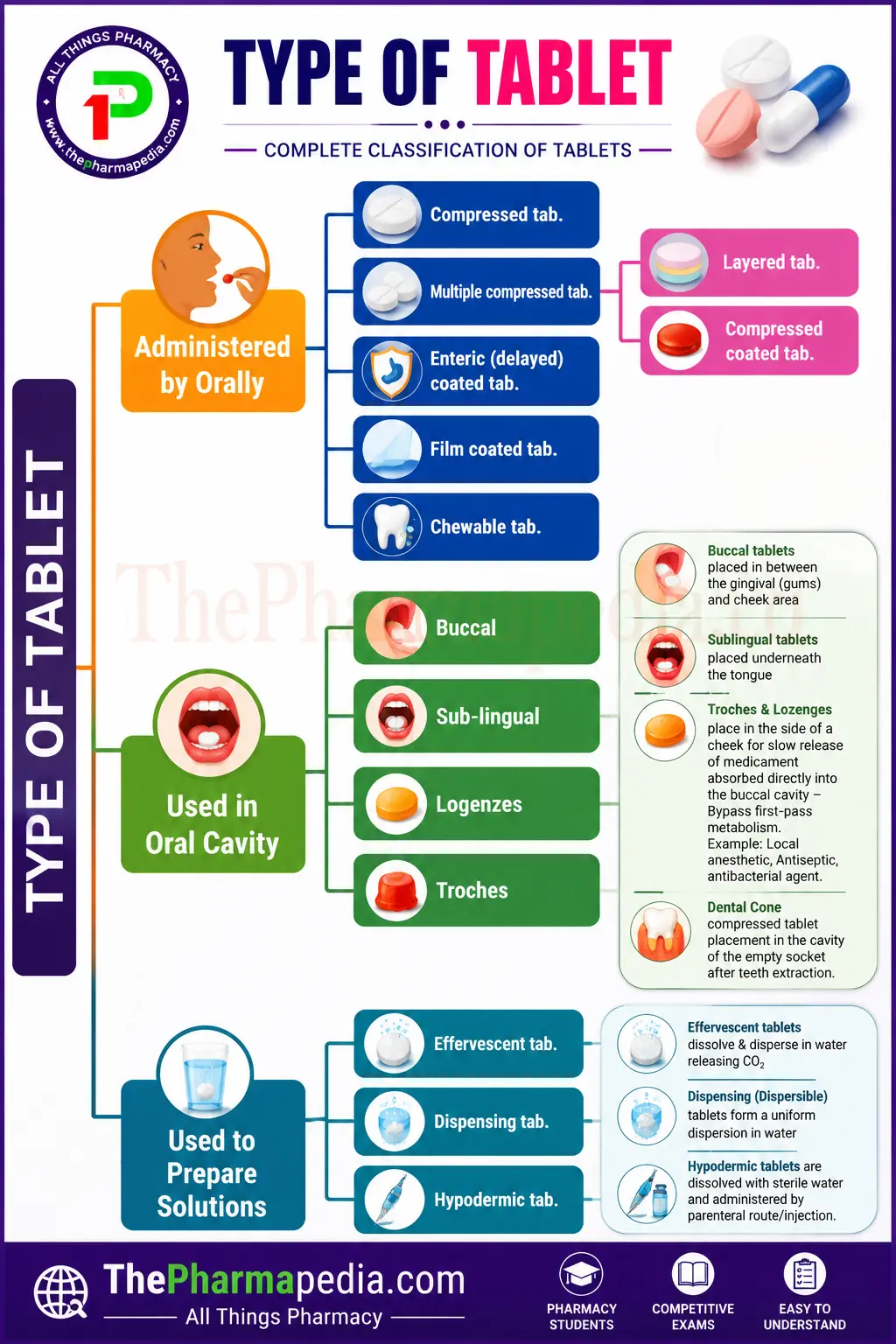
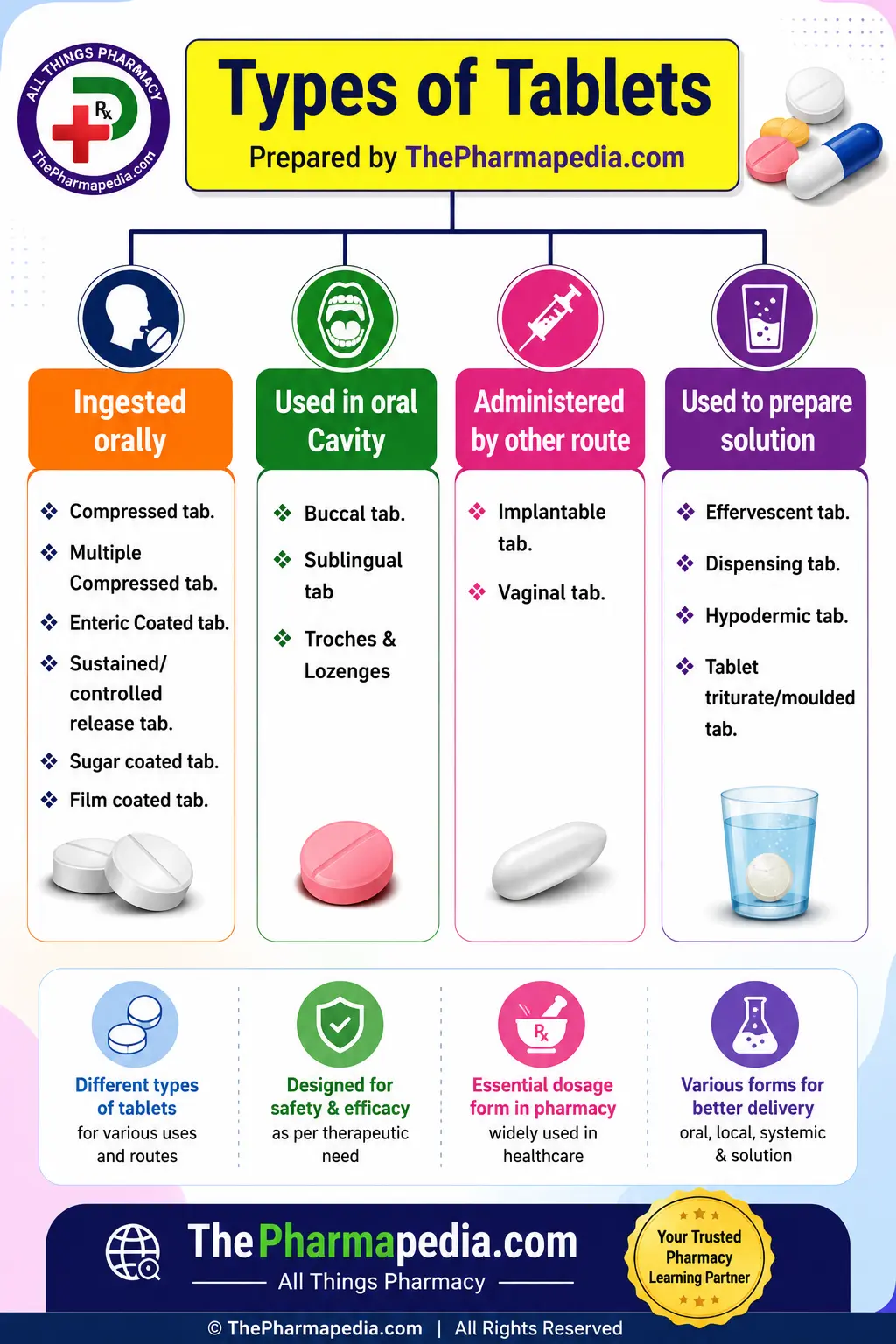
Uncoated Tablet
A single layer or more than one layer of formulation that consists of active ingredients and excipients compressed together without any additional coat or cover.
Coated Tablet
Tablets that have an additional coating layer added.
Dispersible Tablet
Tablets that have film coats or uncoated tablets that form a uniform dispersion when suspended in water.
Effervescent Tablet
Uncoated tablets intended to dissolve and disperse when mixed with organic acid or bicarbonate to produce gaseous carbon dioxide (CO2). The CO2 disintegrates the tablet to produce a suspension of powdered material that is readily absorbed.
Modified Release Tablet
Coated or uncoated tablets designed to release the active ingredient when the desired activity or condition is reached.
Enteric Coated Tablet
Also called gastro-resistant, these tablets are resistant to acidic gastric juices.
Prolonged Release Tablet
Also called extended-release or sustained-release tablets. Formulated so that the release of active ingredients is controlled over a prolonged period. Special excipients are needed to produce these.
Soluble Tablet
Tablets that are dissolved in water before being administered. These may be coated or uncoated.
Tablets for Mouth Use
Formulated to release active ingredients when placed in the buccal cavity or mouth area. Used when a patient has difficulty swallowing or when fast release into the bloodstream is required.
Buccal tablets
Placed in between the gingival (gums) and cheek area.
Sublingual tablets
Placed underneath the tongue.
Troches & Lozenges
Placed in the side of a cheek for slow release of medicament absorbed directly into the buccal cavity, bypassing first-pass metabolism.
Examples: Local anesthetic, antiseptic, antibacterial agent.Dental Cone
Compressed tablet placed in the cavity of the empty socket after teeth extraction.
Implantable Tablets
Tablets that are placed in other areas of the body instead of the mouth (e.g., rectal or vaginal tablets).
Chewable Tablet
Placed into the mouth, chewed, and finally swallowed. Has no requirement for disintegration agents.
Hypodermic Tablet
Tablet is dissolved with sterile water and administered by parenteral route/injection.
Advantages of Tablets
- Ease and convenience of use.
- Bitter tasting drugs can be masked with coated tablets.
- Unstable API can be administered through coated tablets.
- Modified release of active ingredients ensures patient’s compliance and increases the therapeutic effect.
- Inexpensive form of dosage.
- Stability of API: Most stable with respect to physical, chemical and microbiological attributes.
- Cheapest oral dosage form, easy to handle, use and carry out with attractive and elegant appearance.
- Cheap, easy to swallow and production does not require any additional processing steps.
- Low manufacturing cost as compared to other solid dosage forms and large-scale production is possible.
- An unpleasant taste can be masked by sugar coating.
- Packing and production is cheap and does not require more space for storage.
Disadvantages of Tablets
- The onset of action of drugs is less compared with the direct routes such as IV.
- Smaller and geriatric patients may find it harder to swallow tablets.
- Drugs which are amorphous and low-density character are difficult to compress into a tablet.
- Hygroscopic drugs are not suitable for compressed tablets.
- Drugs with low or poor water solubility, slow dissolution, high absorbance in GI tract may be difficult to formulate.
- Sensitive to oxygen drugs may require special coating.
MCQs: Types of Tablets
Test your knowledge! Select an answer to see immediate feedback.
Frequently Asked Questions (FAQs) on Types of Tablets
What is a pharmaceutical tablet?
A pharmaceutical tablet is a solid unit dosage form containing one or more medicaments with or without suitable excipients, prepared by molding or compression.
What distinguishes an uncoated tablet from a coated tablet?
An uncoated tablet consists of compressed active ingredients and excipients without any coating, while a coated tablet has an additional layer such as sugar, gum, or polymers.
What is the function of an enteric-coated tablet?
Enteric-coated tablets resist acidic gastric juices and dissolve in the intestine, protecting the drug and preventing stomach irritation.
Define effervescent tablets and state their composition.
Effervescent tablets are uncoated tablets that dissolve with organic acid or bicarbonate to release CO2 and produce a suspension; they contain active medicament plus sodium carbonate and citric or tartaric acid.
What are modified release tablets?
Modified release tablets are designed to release active ingredients at a specific site or time, including delayed-release, prolonged-release, or enteric-coated tablets.
Why are buccal and sublingual tablets used?
They are formulated to release drugs in the mouth for rapid absorption, bypassing first-pass metabolism, useful in patients who have difficulty swallowing.
What is the difference between chewable tablets and soluble tablets?
Chewable tablets are meant to be chewed and swallowed without disintegration agents, while soluble tablets dissolve in water before administration.
What are implantable tablets?
IDDSs are bioengineering devices surgically placed inside the patient’s tissues to avoid first-pass metabolism and reduce the systemic toxicity of the drug by eluting the therapeutic payload in the vicinity of the target tissues.
List some advantages of tablets as a dosage form.
Easy to use, mask unpleasant tastes by coating, stable, cost-effective, and suitable for controlled drug release.
What are common disadvantages of tablets?
Slower onset than IV administration, swallowing difficulty for some patients, and challenges in compressing hygroscopic or poorly soluble drugs.
What role do excipients play in tablet formulation?
Excipients aid in processing, stability, bioavailability, and mask taste or assist in modified release.
What is a dental cone?
A compressed tablet placed in the socket after tooth extraction to aid healing.
What is a hypodermic tablet?
A tablet dissolved in sterile water for parenteral (injection) administration.
Why are sugar-coated tablets preferred for bitter drugs?
They mask the unpleasant taste and improve patient compliance.
What is the importance of the polymer coating in enteric tablets?
It protects the drug from stomach acid and ensures release in the intestine.
Also Read….
Sugar Coating of tablets: Pharmaceutics
Defect of Sugar-coating tablet
Processing of Pharmaceutical Tablets
📢 Join Our Pharma Community
Stay updated with Pharmacy Previous Papers, Pharma Jobs, GPAT Notes, Study Materials, Admission Alerts & Pharma News.

Join WhatsApp Channel
Get instant updates on Pharmacy Previous Year Papers, Pharma Job Notifications, Study Materials, Admission Alerts and Pharma News.
Join WhatsApp
Join Telegram Channel
Receive latest updates about Pharmacy Previous Papers, Pharma Jobs, GPAT Materials, Admissions, Notes and Pharma News.
Join TelegramJoin Telegram Group
Download FREE Books & Notes, D.Pharm, B.Pharm, M.Pharm, GPAT, Drug Inspector Previous Papers and much more.
Join Group