
- Parenteral Product: Pharmaceutics
- Introduction to Parenteral Preparations
- 5 Main Types of Parenteral Preparations
- Why are Parenteral Dosage Forms Preferred?
- Unique Characteristics of Parenteral Products
- Types of parenteral dosage forms
- Formulation of Parenteral Preparation
- Aqueous Vehicle ( Pharmaceutical water)
- Non Aqueous Vehicle for parenteral Preparation
- 2. Additive/added substances in Parenteral Sterile Preparation/product
- MCQs: Formulation of Parenteral Sterile Preparation
- 1. What is the main requirement for formulations intended for parenteral administration?
- 2. Which of the following is NOT a route for parenteral administration?
- 3. Parenteral formulations must be free from:
- 4. What type of containers are commonly used for parenteral products?
- 5. Which technique is primarily used to prepare sterile parenteral products?
- 6. What is the key reason to avoid pyrogens in parenteral formulations?
- 7. Which of the following is used to remove microorganisms in sterile filtration?
- 8. Parenteral formulations are generally isotonic to avoid:
- 9. Which pharmaceutical dosage form is designed for parenteral administration?
- 10. Pyrogens are typically detected by which test?
- 11. What does ‘aseptic filling’ refer to?
- 12. Which of the following is a critical quality control test for parenteral products?
- 13. Which of the following excipients stabilizes parenteral formulations?
- 14. Which is a common solvent used in parenteral formulations?
- 15. Which parenteral route offers the fastest drug onset?
- 16. Which is NOT a characteristic of an ideal parenteral formulation?
- 17. What is the purpose of lyophilization in parenteral drug formulation?
- 18. The term ‘endotoxin’ refers to:
- 19. Which iso-osmotic agent is frequently used in parenteral formulations?
- 20. What is the USP limit for particulate matter in parenteral solutions?
- 📢 Join Our Pharma Community
Parenteral Product: Pharmaceutics
Introduction to Parenteral Preparations
- Parenteral drug products are the dosage forms intended for administration by a route that does not involve the gastrointestinal (GI) tract (thus, parenteral). Most parenteral drug products are injectable dosage forms intended for administration by injection using a syringe and a needle.
- Parenteral preparations are sterile preparations containing one or more active ingredients intended for administration by injection, infusion, or implantation into the body. They are packaged in either single-dose or multidose containers.
- These preparations may be directly administered or may require reconstituting or diluting prior to administration.
5 Main Types of Parenteral Preparations
- Injection
- Infusion
- Powder for Injection
- Concentrated Solution for Injection
- Implants
1. Infusions
These parenteral preparations are composed of a sterile aqueous solution with water as its continuous phase. The preparations are free from bacterial endotoxins or pyrogens and are turned isotonic with blood. They do not contain any antimicrobial preservatives.
2. Powder for Injection
These are sterile solid compounds that are distributed in their final volume when the vial or container is shaken to form a clear particle-free solution.
3. Concentrated Solutions for Injections
The concentrated solutions are diluted with water for injection before they are administered through injection or through intravenous infusion.
4. Implants
These solid sterile preparations are implanted in the tissue in order to release the active ingredient for long periods. They are stored in sterile containers individually.
Why are Parenteral Dosage Forms Preferred?
Parenteral dosage forms are preferred for one or more of the following reasons:
- Low oral bioavailability and/or high variability in oral drug absorption.
- Instability of the drug in the GI tract. For example, most protein drugs are highly unstable.
- Rapid onset of drug action is desired.
- Ability to immediately stop drug administration is important. For example, most emergency room medications and anesthetics.
- High degree of flexibility in dosage adjustment with or without real-time patient physiological response is needed. For example, emergency medications such as analgesics, anticancer drugs, and fertility medications.
Unique Characteristics of Parenteral Products
- Must be absolutely sterile.
- Must be free from pyrogenic (endotoxin) contamination.
- Must be free from visible particulate matter.
- Must be isotonic to body fluid.
- Must be stable (chemically, physically, microbiologically) throughout the shelf life.
- Products must be compatible with diluents/additives, delivery systems & other co-administered products.
Types of parenteral dosage forms
Small-volume parenteral versus large-volume parenteral
Injectable parenteral drug products are available as single or multiuse containers in different container–closure systems and volumes. Small-volume parenterals (SVPs) are available in volumes of less than 1 ml, and up to 50 ml. Large-volume parenterals (LVPs) are usually packaged in volumes up to 1000 mL.
NutritionSVPs include both unit-dose and single-dose and multidose containers. Unit dose containers are usually hermetically sealed ampoules that are intended to be discarded after a single injection. Multidose containers, on the other hand, are usually rubber-stoppered and sealed glass vials that are intended for multiple injections. The drug for each injection is withdrawn by inserting the needle through the rubber stopper, which self-seals after the needle is withdrawn.
SVPs for IV injection may not be isotonic because the large volume of blood rapidly dilutes them. However, hypertonic solutions tend to be tissue irritants. The pH of SVPs can also vary from the physiological pH because the blood buffering system rapidly readjusts the pH after a small volume injection. SVPs for single-dose administration may be free of antimicrobial preservatives, but multidose vials usually have the preservatives to ensure sterility over multiple uses over a certain period of time.
Injections versus infusions
Injection and infusion are the predominant methods of parenteral administration. Injection via different routes of administration usually utilizes an SVP. An infusion involves the IV administration of LVP over a prolonged period of time. Infusions are commonly used for fluid replacement, administration of drugs with a short plasma half-life, and/or dilution of a drug immediately before administration.
Formulation of Parenteral Preparation
Parenteral products can be formulated as solutions, suspensions, emulsions, or lyophilized products (solid) for reconstitution immediately before use.
Parenteral preparations may require the use of excipients such as solvents, substances to enhance solubility, suspending agents, buffering agents, substances to make the preparation isotonic with blood, stabilizers or antimicrobial preservatives. The addition of excipients is kept to a minimum.[cite: 1] When excipients are used they do not adversely affect the stability, bioavailability, safety or efficacy of the active ingredient(s),
- Vehicles
- Added Substance
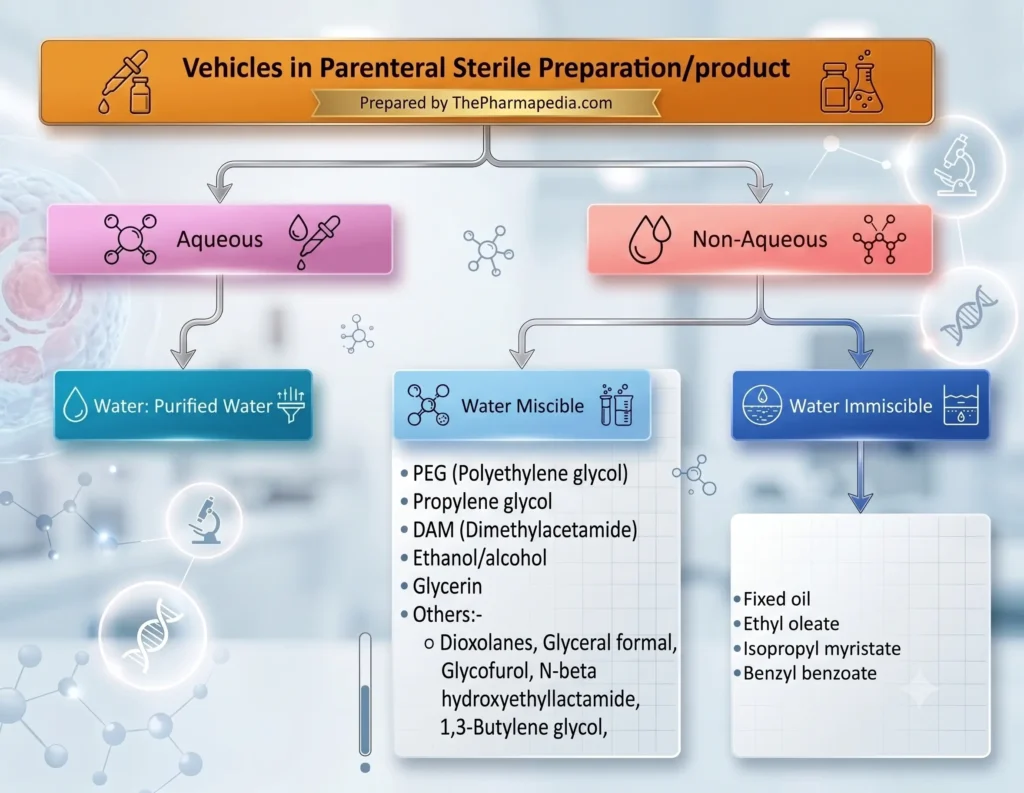
1. Vehicles in Parenteral Preparation/product
- Aqueous Vehicle ( Pharmaceutical water)
- Non-Aqueous Vehicle
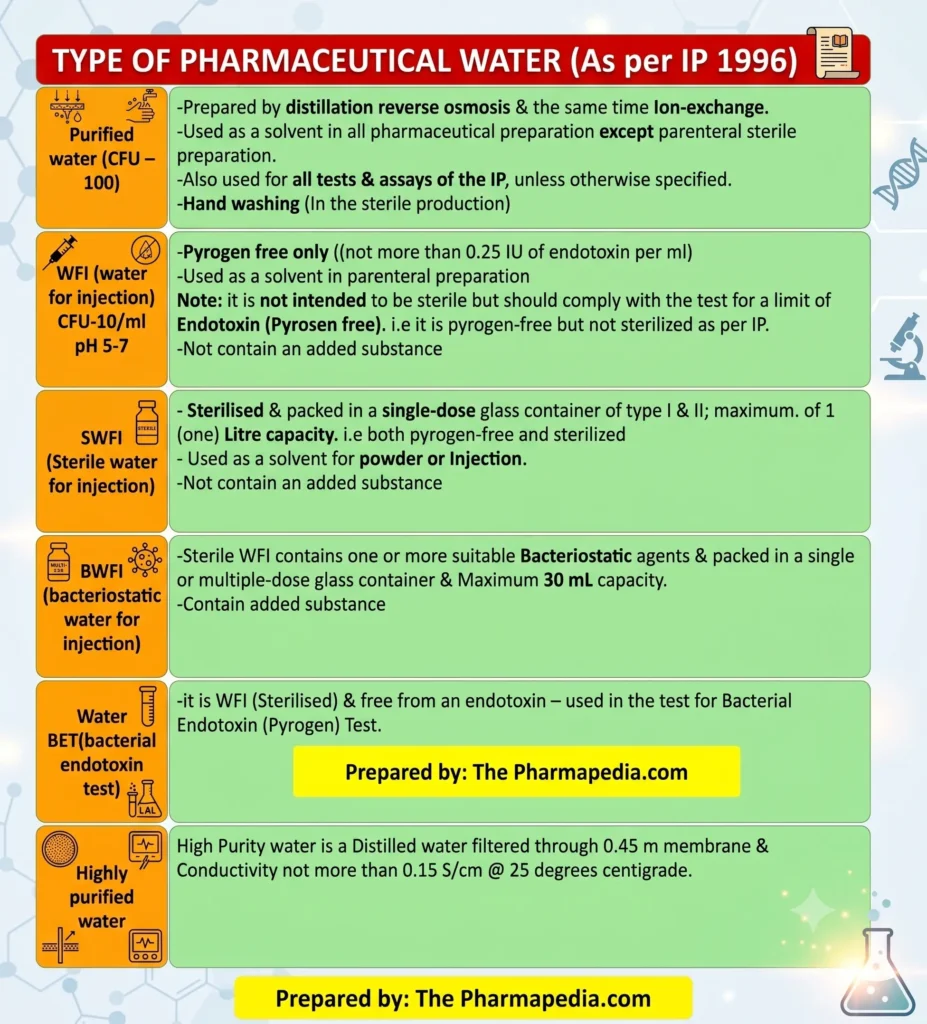
Aqueous Vehicle ( Pharmaceutical water)
| Type of Water | Description (As per Indian Pharmacopoeia) |
|---|---|
| Purified water CFU – 100 |
-Prepared by distillation reverse osmosis & the same time Ion-exchange. -Used as a solvent in all pharmaceutical preparation except parenteral sterile preparation. -Also used for all tests & assays of the IP, unless otherwise specified -Hand washing (In the sterile production) |
| WFI CFU-10/ml pH 5-7 |
-Pyrogen free only ((not more than 0.25 IU of endotoxin per ml) -Used as a solvent in parenteral preparation Note: it is not intended to be sterile but should comply with the test for a limit of Endotoxin (Pyrosen free). i.e it is pyrogen-free but not sterilized as per IP. -Not contain an added substance |
| SWFI content provided by ThePharmapedia.com |
– Sterilised & packed in a single-dose glass container of type I & II; maximum. of 1 (one) Litre capacity. i.e both pyrogen-free and sterilized – Used as a solvent for powder or Injection. -Not contain an added substance |
| BWFI notes by The Pharmapedia |
-Sterile WFI contains one or more suitable Bacteriostatic agents & packed in a single or multiple-dose glass container & Maximum 30 mL capacity. -Contain added substance |
| Water BET (bacterial endotoxin test)[cite: 1] | it is WFI (Sterilised) & free from an endotoxin – used in the test for Bacterial Endotoxin (Pyrogen) Test. |
| Highly purified water | High Purity water is a Distilled water filtered through 0.45 m membrane & Conductivity not more than 0.15 S/cm @ 25 degrees centigrade. |
Non Aqueous Vehicle for parenteral Preparation
– Vegetable origin Oil
- Fixed oil of vegetable origin.
- Should be metabolized in the body
- Should be liquid at room temp.
- Not to be rancid rapid
- Eg. Corn oil, Seasam oil, almond oil, peanut oil, cotton seed oil etc[cite: 1]
Oil subject to test:
- Fatty acid content
- Iodine value
- Saponification value
Non-Aqueous vehilce is used in the preparation of progesterone, testosterone injection, fat soluble vitamin injection.
Lecithin – used as emulsifier agent in Non-Aqueous vehicles.
2. Additive/added substances in Parenteral Sterile Preparation/product
- a. Antimicrobial Agents
- b. Buffers
- c. Anti-oxidants
- d. Tonicity agents
- e. Cryoprotectants & Lyoprotectants
a. Antimicrobial Agents in parenteral sterile product
- Must be added to preparations contained in multiple dose container [30mL & max 10 withdrawal]
- Used to prevent the growth of Microorganism
- E.xample-
- Phenyl mercuric nitrate 0.002 % [limit 0.01%]
- Methyl paraben – 0.18%
- Propyl paraben – 0.02%
- Benzyl alcohol – 2% – also have local anesthetic property
- Benzalkanium chloride & benzene thorium chloride – 0.01%
- Phenol/cresol – 0.5%
- Chlorobutanol – 0.5%
- Mercurials are not used because of mercury toxicity.
- Product without preservatives must be used immediately (within 3 hrs) after opening the package
| S. No. | Additives | Concentration range (%) |
|---|---|---|
| 1. | Benzalkonium chloride | 0.01 |
| 2. | Benzethonium chloride | 0.01 |
| 3. | Benzyl alcohol | 0.5-10.0 |
| 4. | Butylparaben | 0.015 |
| 5. | Chlorobutanol | 0.25-0.5 |
| 6. | Metacresol | 0.1-0.25 |
| 7. | Methy paraben | 0.01-0.18 |
| 8. | Phenol | 0.065-0.5 |
| 9. | Phenylmercuric nitrate | 0.001 |
| 10. | Propylparaben | 0.005-0.035 |
| 11. | Thimerosal | 0.001-0.02 |
b. Buffers in parenteral sterile product
Used to stabilize a solution against chemical-physical degradation that might occur if the pH changes. Eg. Acid salt of citrates, phosphates.
| S. No. | Additives | Concentration range (%) |
|---|---|---|
| 1. | Acetic acid | 0.22 |
| 2. | Adipic acid | 1.0 |
| 3. | Benzoic acid and sodium benzoate | 5.0 |
| 4. | Citric acid | 0.5 |
| 5. | Lactic acid | 0.1 |
| 6. | Maleic acid | 1.6 |
| 7. | Potassium phosphate | 0.1 |
| 8. | Sodium phosphate mono basic | 1.7 |
| 9. | Sodium phosphate dibasic | 0.71 |
| 10. | Sodium acetate | 0.8 |
| 11. | Sodium bicarbonate | 0.115 |
| 12. | Sodium carbonate | 0.06 |
| 13. | Sodium citrate | 4.0 |
| 14. | Sodium tartrate | 1.2 |
| 15. | Tartaric acid | 0.65 |
c. Anti-oxidants used in parenteral sterile product
- Sodium bisulfite
- BHT
- Sodium metasulfite
- BHA
- Ascorbic acid
- Tochopherols
- EDTA
- Displaying O2 in above the solution by purging N2 (inert gas)
| S. No. | Additives | Concentration range (%) |
|---|---|---|
| Reducing agents | ||
| 1. | Ascorbic acid | 0.02-0.1 |
| 2. | Sodium bisulfite | 0.1-0.15 |
| 3. | Sodium metabisulfite | 0.1-0.15 |
| 4. | Sodium formaldehyde sulfoxide | 0.1-0.15 |
| 5. | Thiourea | 0.005 |
| Blocking agents | ||
| 6. | Ascorbic acid esters | 0.01-0.015 |
| 7. | Butyl hydroxytoluene (BHT) | 0.005-0.02 |
| 8. | Tocopherols | 0.05-0.075 |
| Synergist agents | ||
| 9. | Ascorbic acid | 0.01-0.05 |
| 10. | Citric acid | 0.005-0.01 |
| 11. | Citraconic acid | 0.03-0.45 |
| 12. | Phosphoric acid | 0.005-0.01 |
| 13. | Tartaric acid | 0.01-0.02 |
| Chelating agents | ||
| 14. | Ethylenediaminetetraacetic acid salts | 0.01-0.075 |
d. Tonicity agents used in parenteral sterile product
- Used in Parenteral & Ophthalmic products.
- 0.9% w/v NaCl solution Used to adjust tonicity of the solution
- Injectable product to be isotonic with physiological fluids.
- Isotonic preparation- use to minimize pain & tissue irritation at the site of application.
- Eg. Electrolytes,NaCl or mono/disaccharide sugar
e. Cryoprotectant & Lyoprotactant
- Used to protect Bio-pharmaceutical product from adverse effects during freeze-drying processing.
- Eg. – Sugars (Non-reducing)- sucrose, Amino acids- glysine & lysine; Polymer – Liq PEG, dextran; Polyols – mannitol, sorbitol
MCQs: Formulation of Parenteral Sterile Preparation
1. What is the main requirement for formulations intended for parenteral administration?
View Answer
2. Which of the following is NOT a route for parenteral administration?
View Answer
3. Parenteral formulations must be free from:
View Answer
4. What type of containers are commonly used for parenteral products?
View Answer
5. Which technique is primarily used to prepare sterile parenteral products?
View Answer
6. What is the key reason to avoid pyrogens in parenteral formulations?
View Answer
7. Which of the following is used to remove microorganisms in sterile filtration?
View Answer
8. Parenteral formulations are generally isotonic to avoid:
View Answer
9. Which pharmaceutical dosage form is designed for parenteral administration?
View Answer
10. Pyrogens are typically detected by which test?
View Answer
11. What does ‘aseptic filling’ refer to?
View Answer
12. Which of the following is a critical quality control test for parenteral products?
View Answer
13. Which of the following excipients stabilizes parenteral formulations?
View Answer
14. Which is a common solvent used in parenteral formulations?
View Answer
15. Which parenteral route offers the fastest drug onset?
View Answer
16. Which is NOT a characteristic of an ideal parenteral formulation?
View Answer
17. What is the purpose of lyophilization in parenteral drug formulation?
View Answer
18. The term ‘endotoxin’ refers to:
View Answer
19. Which iso-osmotic agent is frequently used in parenteral formulations?
View Answer
20. What is the USP limit for particulate matter in parenteral solutions?
View Answer
📢 Join Our Pharma Community
Stay updated with Pharmacy Previous Papers, Pharma Jobs, GPAT Notes, Study Materials, Admission Alerts & Pharma News.

Join WhatsApp Channel
Get instant updates on Pharmacy Previous Year Papers, Pharma Job Notifications, Study Materials, Admission Alerts and Pharma News.
Join WhatsApp
Join Telegram Channel
Receive latest updates about Pharmacy Previous Papers, Pharma Jobs, GPAT Materials, Admissions, Notes and Pharma News.
Join TelegramJoin Telegram Group
Download FREE Books & Notes, D.Pharm, B.Pharm, M.Pharm, GPAT, Drug Inspector Previous Papers and much more.
Join Group