
Introduction
In pharmaceutics, emulsions are biphasic systems consisting of two immiscible liquids—commonly oil and water—stabilized by an emulsifying agent. Correct identification of the type of emulsion (oil-in-water or water-in-oil) is essential for formulation stability, drug release, and therapeutic efficacy.
The following are important laboratory and physical methods used for the identification of emulsions in pharmaceutical formulations.
🧫 Methods for Identification of Emulsions
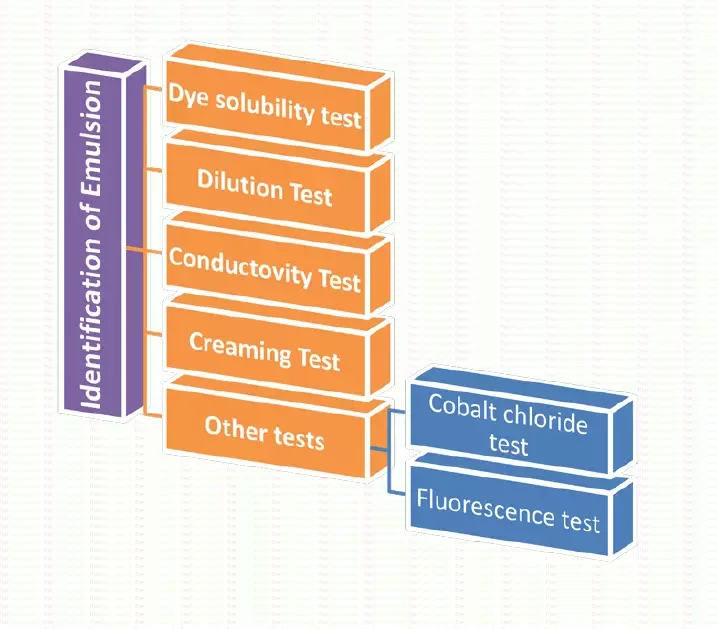
1. Dye Solubility Test
This test identifies the continuous (external) phase based on dye solubility.
- Water-soluble dyes (e.g., Amaranth, Methylene Blue) produce a uniform tint in Oil-in-Water (O/W) emulsions.
- Oil-soluble dyes (e.g., Sudan III, Scarlet Red) produce a uniform tint in Water-in-Oil (W/O) emulsions.
✅ Observation:
O/W → colored uniformly with water-soluble dye
W/O → colored uniformly with oil-soluble dye
2. Dilution Test
This method is based on the miscibility of the emulsion with its external phase.
- When the dispersion medium (external phase) is added, no phase separation occurs.
- For an O/W emulsion – adding water causes no separation, but adding oil causes phase separation.
- For a W/O emulsion – adding oil causes no separation, but adding water causes phase separation.
✅ Observation:
Miscible with external phase = identifies type of emulsion.
3. Conductivity Test
This test depends on the ability of the emulsion to conduct electricity.
- If the water phase is continuous (O/W type), the emulsion conducts electricity.
- If the oil phase is continuous (W/O type), it does not conduct electricity.
✅ Observation:
O/W → conducts electricity
W/O → does not conduct electricity
4. Creaming Test
This test observes the direction of creaming (the upward or downward movement of the dispersed phase).
- O/W emulsion: Creams upwards (oil is lighter than water).
- W/O emulsion: Creams downwards (water is heavier than oil).
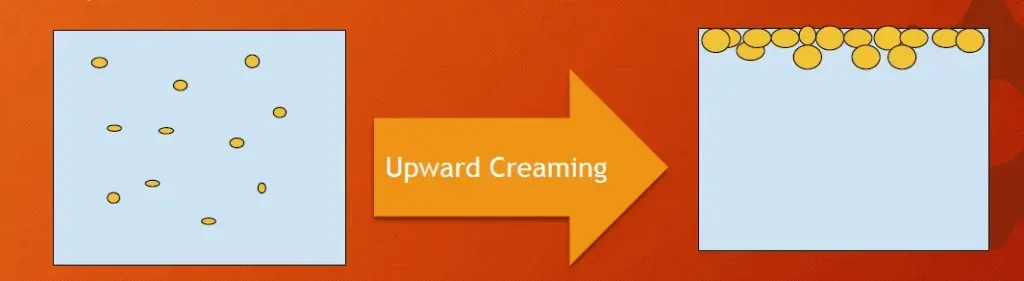
✅ Observation:
Direction of creaming helps distinguish the type of emulsion.
5. Other Identification Tests
a. Cobalt Chloride Paper Test
- A filter paper soaked in cobalt chloride turns blue to pink when exposed to an O/W emulsion (due to water contact).
✅ Observation: Blue → Pink = O/W type.
b. Fluorescence Test
- Under UV light, W/O emulsions show uniform fluorescence, while O/W emulsions show spotty fluorescence.
✅ Observation:
Uniform → W/O
Spotty → O/W
🧠 Summary Table: Identification of Emulsion Types
| Test | O/W Emulsion | W/O Emulsion |
|---|---|---|
| Dye Solubility Test | Water-soluble dye gives uniform color | Oil-soluble dye gives uniform color |
| Dilution Test | Miscible with water | Miscible with oil |
| Conductivity Test | Conducts electricity | Does not conduct electricity |
| Creaming Test | Creams upwards | Creams downwards |
| Cobalt Chloride Test | Blue → Pink | No color change |
| Fluorescence Test | Spotty fluorescence | Uniform fluorescence |
🎯 Conclusion
The identification of emulsions is crucial in pharmaceutical formulation and quality control. Using tests like dye solubility, conductivity, and dilution, one can easily differentiate between O/W and W/O emulsions. These simple methods help ensure the correct type of emulsion is formulated for optimal drug delivery and stability.
FAQs on Identification of Emulsions
1. What is the purpose of identifying emulsions in pharmaceutics?
Identification helps determine the type (O/W or W/O), ensuring formulation stability and proper drug release.
2. Which dye is used in the dye solubility test for O/W emulsions?
Water-soluble dyes such as Amaranth or Methylene Blue.
3. What happens when an O/W emulsion is diluted with oil?
Phase separation occurs.
4. Which emulsion type conducts electricity?
Oil-in-water (O/W) emulsion.
5. Why does a W/O emulsion cream downward?
Because the dispersed phase (water) is denser than the continuous oil phase.
6. How does the cobalt chloride test identify emulsion type?
Paper turns from blue to pink in the presence of water (O/W emulsion).
7. What kind of fluorescence is shown by O/W emulsions?
Spotty fluorescence.
8. What kind of fluorescence is shown by W/O emulsions?
Uniform fluorescence.
9. What is the principle behind the dilution test?
Miscibility with the external phase indicates emulsion type.
10. Which test is based on electrical conductivity?
Conductivity test.
MCQs on Identification of Emulsions
1. Which of the following dyes gives a uniform tint in O/W emulsions?
a) Sudan III
b) Methylene Blue
c) Scarlet Red
d) None
✅ Answer: b) Methylene Blue
2. Oil-soluble dye Sudan III forms a uniform color in which type of emulsion?
a) O/W
b) W/O
c) Multiple emulsion
d) None
✅ Answer: b) W/O
3. O/W emulsion is miscible with:
a) Water
b) Oil
c) Alcohol
d) Ether
✅ Answer: a) Water
4. Conductivity test is positive for:
a) W/O
b) O/W
c) Both
d) None
✅ Answer: b) O/W
5. W/O emulsion creams in which direction?
a) Upwards
b) Downwards
c) Both directions
d) No creaming
✅ Answer: b) Downwards
6. In the cobalt chloride test, blue to pink color change indicates:
a) W/O emulsion
b) O/W emulsion
c) Multiple emulsion
d) None
✅ Answer: b) O/W emulsion
7. Fluorescence is uniform in:
a) O/W emulsion
b) W/O emulsion
c) Both
d) None
✅ Answer: b) W/O emulsion
8. Which test depends on miscibility with the external phase?
a) Conductivity test
b) Dye solubility test
c) Dilution test
d) Creaming test
✅ Answer: c) Dilution test
9. The direction of creaming helps to identify:
a) Type of emulsion
b) Particle size
c) pH of emulsion
d) Emulsifier concentration
✅ Answer: a) Type of emulsion
10. Which of the following emulsions conducts electricity?
a) W/O
b) O/W
c) Both
d) None
✅ Answer: b) O/W